What Is GEO and Why Indian Businesses Can't Ignore It
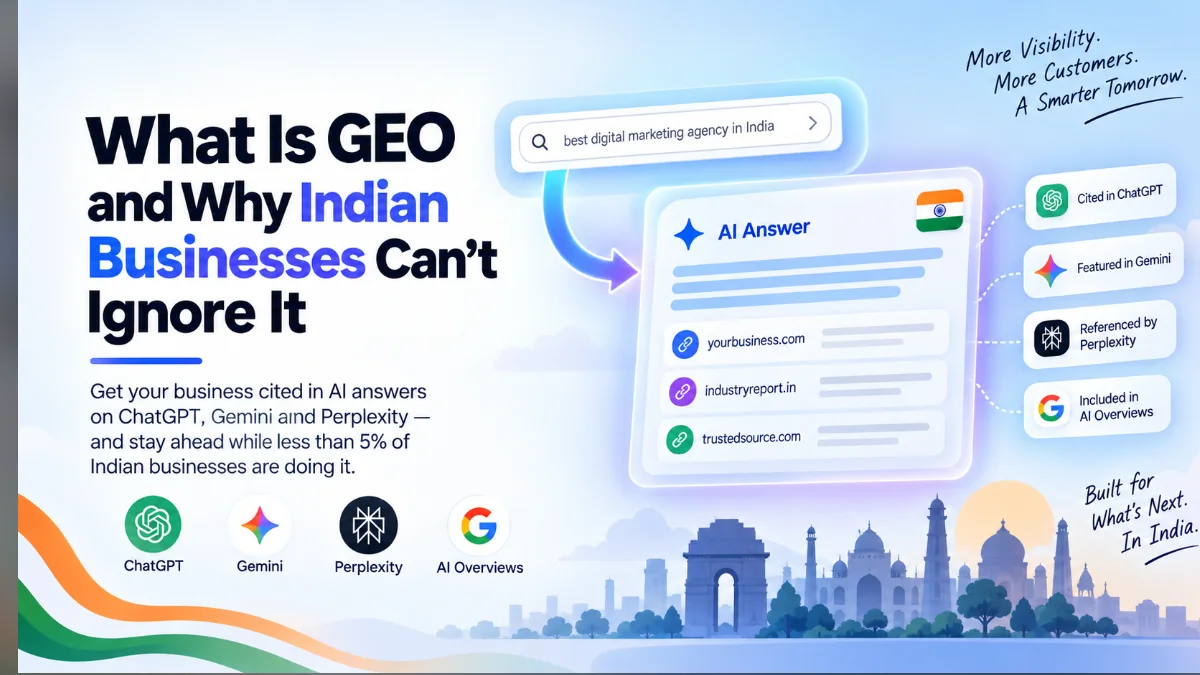
GEO (Generative Engine Optimization) helps your business get cited in AI answers on ChatGPT, Gemini and Perplexity — and less than 5% of Indian businesses are doing it.
Generative Engine Optimization (GEO) is the practice of making your business visible inside AI-generated answers — on ChatGPT, Google Gemini, Perplexity, and similar platforms — rather than only optimizing to appear in a list of blue links on a traditional search page. In India right now, this matters more than most business owners realize: monthly searches for AI tools and AI-generated content hit 235 million in 2026, up 154% year-on-year, while fewer than 5% of Indian businesses have any GEO strategy in place at all. That gap is the opportunity.
Key takeaways:
- GEO optimizes for AI-generated answers; SEO optimizes for traditional search result lists — you need both, not one or the other
- ChatGPT has over 95 million monthly active users in India; 67% of Indian internet users aged 18-35 have tried at least one AI search tool
- AI platforms cite sources that are specific, authoritative, and clearly structured — the same content signals that work for Featured Snippets
- Less than 5% of Indian businesses have started on GEO — the window to get in early is genuinely open right now
GEO vs SEO: What's Actually Different
| Factor | Traditional SEO | GEO (Generative Engine Optimization) |
|---|---|---|
| Where you appear | Google/Bing search result list | AI-generated answers inside ChatGPT, Gemini, Perplexity, AI Overviews |
| How users interact | Click a link, land on your page | Read a synthesized answer — your site may be cited within it |
| What signals matter | Backlinks, keywords, technical health | Clarity, specificity, authority, citation-worthiness |
| Traffic type | Direct click-through | Brand awareness + citation traffic (some direct, some indirect) |
| Competition level in India | High and growing | Very low — less than 5% of Indian businesses have started |
What Exactly Is Generative Engine Optimization?
GEO is making your content easy for AI systems to understand, trust, and cite when a user asks a question your business could genuinely answer. When someone asks ChatGPT "what's a good local SEO agency in India" or asks Gemini "how do I speed up my small business website," those AI systems pull from indexed, trustworthy, clearly-structured web content to build their answer — and the businesses whose content is clearest, most specific, and most credible are the ones that get cited. GEO is the work of becoming that content.
This is different from traditional SEO in one key way: a traditional search result is a list where position matters, but a user still chooses what to click. An AI-generated answer is a synthesized response where the AI has already chosen which sources to trust and cite before the user even sees the answer. Getting into that synthesis is the goal of GEO.
Why Does This Matter Specifically for Indian Businesses Right Now?
Two numbers tell the story: <cite index="21">average monthly searches for AI adoption in India hit 235 million, a 154% rise year-on-year</cite>, and <cite index="24">less than 5% of Indian businesses have a GEO strategy</cite>. Indian consumers — especially under-35, urban, and increasingly small-city audiences — are already using AI tools to research products, find services, and make decisions. The businesses that show up in those AI-generated answers are building brand awareness and credibility in the channel their customers are shifting to, while most of their competitors haven't even noticed the shift yet.
This is a rare situation where being early is genuinely low-cost: GEO doesn't require a separate technical platform or large budget, it requires applying the same content discipline that good SEO already demands, more rigorously and specifically.
How Is GEO Different From Trying to Rank in Google's AI Overviews?
Google's AI Overviews are one surface of GEO, but not the whole picture — <cite index="24">GEO optimizes for AI engines like ChatGPT, Gemini, Perplexity, and Claude that generate answers instead of lists</cite>, across all of them, not just Google's own AI features. The underlying principles are similar across platforms, but a business focused only on Google AI Overviews is missing the broader shift to AI-native search behavior across multiple platforms where Indian users are increasingly spending time.
What Does Content Actually Need to Look Like to Get Cited in AI Answers?
AI systems favor content that is specific, clearly structured, genuinely authoritative on the topic, and directly answers a real question — not vague brand positioning, not keyword-stuffed paragraphs, not generic industry overviews. Concretely, this means:
- Direct answers in the first paragraph, before context or background
- Specific numbers, ranges, and real examples rather than vague claims
- Clear question-and-answer structure (exactly what a good FAQ section does)
- Named, verifiable sources or credentials where claims are made
- Original insights or data that aren't just summaries of what every other article already says
This should sound familiar — it's the same structure we've built into every post on this blog deliberately. The discipline that wins Featured Snippets is almost exactly the discipline that wins AI citations, which is why businesses that have done good SEO already have a head start on GEO.
“"Less than 5% of Indian businesses have a GEO strategy right now. That's not a warning — it's a window. The businesses that treat AI search as a channel to build in now, rather than react to later, are building an advantage that gets harder to close the longer competitors wait to start." — the pattern we're watching play out in real time across our own content strategy.”
How to Start GEO Without Starting From Scratch
If you already have a website and have done any SEO work, you're closer to a GEO baseline than you think. Here's the order that makes sense:
- Audit your existing content for specificity — replace vague claims with specific ones, add real numbers where you currently say "many" or "often"
- Add direct-answer opening paragraphs to every important page — the first 40-60 words should directly answer the page's main question before any context
- Expand or add FAQ sections on your service and blog pages using real questions real customers ask you
- Add or clean up structured data (schema markup) — FAQPage, Organization, and LocalBusiness schema specifically help AI systems understand what your page is about
- Build genuine authorship signals — a real About page, named authors, verifiable credentials — since AI systems factor source credibility into what they cite
- Claim your business on AI platforms — some AI search tools allow business listing verification separately from Google, worth doing early
Struggling to Rank on Page 1 of Google?
Our engineering team builds SEO structures and schema wiring that drive rank #1 search positions.
The One Thing That Hurts GEO Faster Than Anything Else
Fabricated credentials, stock-photo teams presented as real staff, and unverifiable statistics stated as facts — exactly the patterns that already undermine traditional E-E-A-T — also actively work against GEO. AI systems are increasingly trained to weight source credibility, and a site with visible authenticity gaps (fake bios, invented stats, placeholder content left live) is precisely what those credibility filters are designed to discount. Building real trust signals isn't just an SEO fix — it's the foundation that GEO sits on.
Frequently Asked Questions
Q: Does GEO replace SEO, or do I need both?
A: Both — traditional search still drives the majority of traffic for most businesses, but AI-generated answers are a fast-growing additional channel that the same content fundamentals support, meaning good SEO work already builds the GEO foundation without a completely separate effort.
Q: How do I know if my content is being cited in AI answers right now?
A: Search for your business name or core services directly in ChatGPT, Gemini, and Perplexity and see what comes up; Google's new Search Console AI reporting also shows AI Overview-specific impressions for your site now that it's rolled out globally.
Q: Is GEO only for large businesses, or can a small local business in India benefit?
A: Small and local businesses can benefit significantly — local and specific questions ("best electrician in Coimbatore," "affordable preschool in Chennai") are exactly the kind of queries AI tools answer by citing specific, locally-relevant content that a small, focused business can produce better than a generic national competitor.
Q: How long does it take to see results from GEO work?
A: AI citation visibility can shift faster than traditional SEO rankings, since AI systems re-index and re-evaluate content relatively frequently, though building the underlying trust signals (authorship, specificity, structured data) takes the same patient consistency as SEO itself.
Want to know how your website currently looks to AI search systems like Gemini and ChatGPT — and what's stopping you from getting cited in their answers? Get a free SEO and GEO audit from Ostrune and we'll show you exactly what needs fixing.
Get a Free Organic SEO & Keyword Audit
Discover high-intent keyword gaps, indexation errors, and schema opportunities to capture top 3 Google rankings.
“0.7s Load Speed | 99/100 Core Web Vitals | Reliable Civic News Delivery”